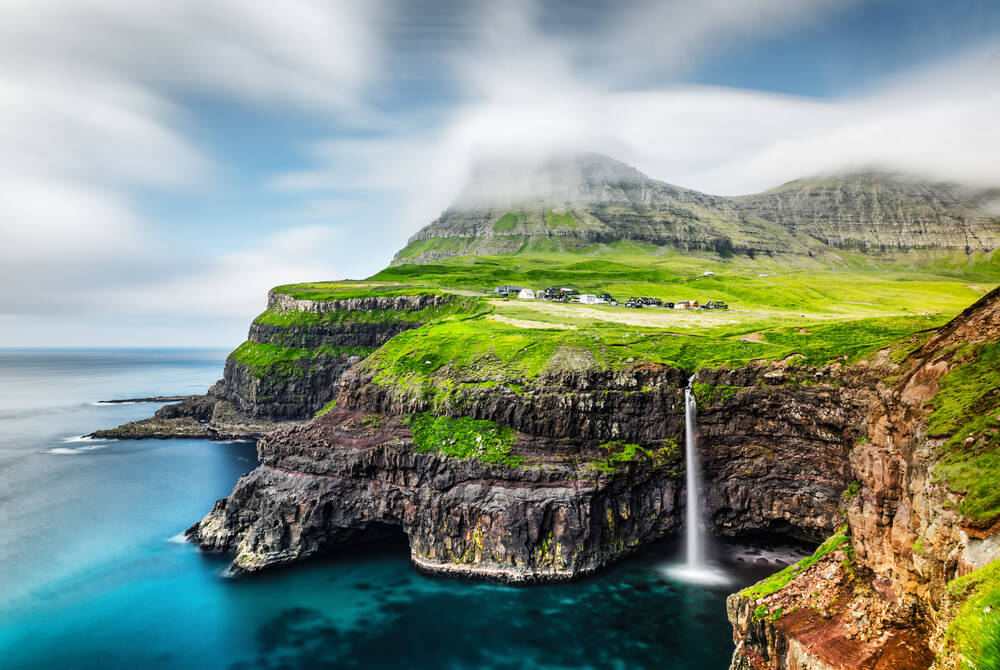
Ever since my first visit to the Faroe Islands back in March 2024, I’ve been intent on returning to explore more of this wild, rugged and endlessly captivating North Atlantic archipelago. From soaring sea cliffs and steep, basalt-layered mountains to mist-cloaked fjords and lush, grassy valleys, the landscapes of these islands inspire a powerful sense of awe and wonder. The towns and villages, meanwhile – many of them dotted with traditional turf-roofed houses – are often just as picturesque as their surroundings. To an extent, the Faroes share certain similarities with Scotland’s northern isles – Shetland, Orkney and the Outer Hebrides being the closest land neighbours – but with more dramatic topography and a distinctly Nordic character. When visiting from the UK, they feel oddly familiar yet simultaneously like a world entirely of their own.
Earlier this year, the idea of a summer trip to the Faroe Islands was floated among a group of my Best Served Scandinavia colleagues, and before long, a plan was set in motion. Having recently returned from our four-day adventure, it’s fair to say all expectations were well and truly exceeded. Here’s how it unfolded…
Day one – Bøur, Múlafossur & Tórshavn
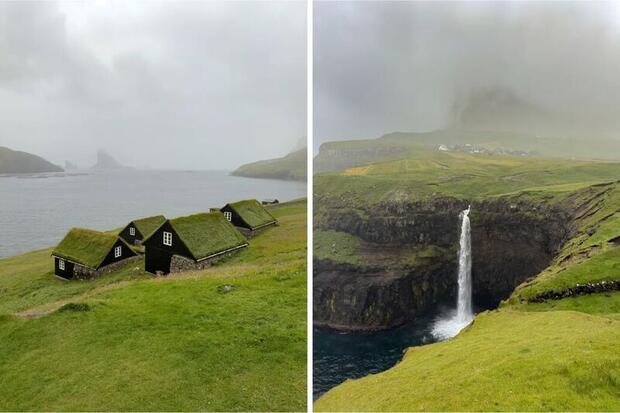
Bøur village (left) & Múlafossur (right)
Flying directly from London Gatwick with Atlantic Airways (a journey of just 1 hour and 50 minutes), we stepped off the plane at Vágar Airport to gloomy, overcast skies and drizzle, with the temperature hovering at a cool 10°C – exactly the kind of weather you can typically expect in the Faroe Islands. Coming from a relentlessly hot and dry UK summer, however, it was refreshing to be greeted by such mild conditions and the novel sight of green, unscorched grass.
The great thing about arriving on the island of Vágar is that there’s plenty to see straight away within striking distance of the airport. After picking up our hire car, we made our way along the coastal road to the tiny village of Bøur, which is home to a beautiful black-and-white church, a cluster of turf-roofed houses and a black sand beach facing out towards the jagged Tindhólmur islet and Drangarnir sea stacks. From there, we continued to Gásadalur, a village that clings to a grassy clifftop just above Múlafossur – the iconic waterfall that tumbles straight into the sea. By this point, the weather had deteriorated and the surrounding mountains were totally obscured by low clouds, so we didn’t hang about for too long taking in the views.
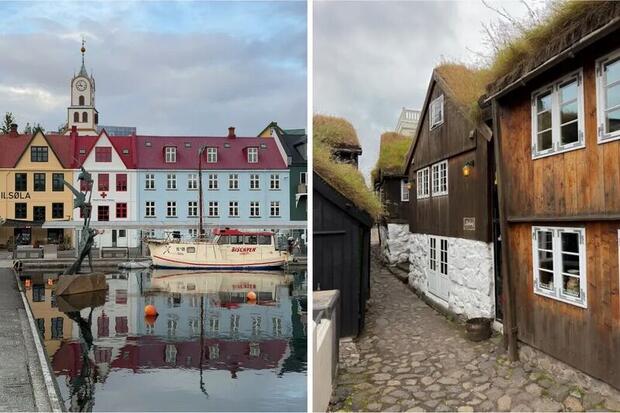
Tórshavn harbour (left) and old town (right)
It was then time to make our way to Tórshavn, the capital of the Faroe Islands, which is spread along the southeastern shore of Streymoy island. To get there, we passed through our first sub-sea tunnel, Vágatunnilin, which connects the neighbouring islands of Vágar and Streymoy. Most of the major points of interest in the Faroe Islands can be reached in less than an hour’s drive from Tórshavn, and with by far the best choice of accommodation and restaurants in the archipelago, it’s an ideal base for day trips. In the evening, we ventured into town for a couple of drinks at a cosy, timber-clad bar (Mikkeller) set within a 500-year-old turf-roofed building in the historic centre – a delightful spot to round off our first day.
Day two – Kalsoy & Klaksvík
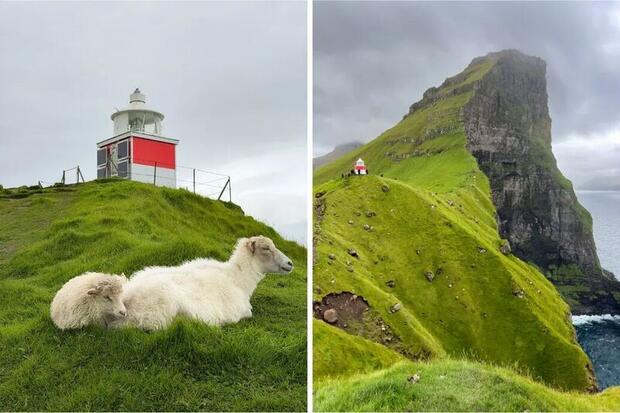
Kallur Lighthouse, Kalsoy
It was an early start on our first morning as we drove (via two sub-sea tunnels) from Tórshavn to Klaksvík, the second largest town in the Faroe Islands, tucked between mountains and fjords on the island of Borðoy. From here, we took a ferry across to Kalsoy – a long, thin island in the northeastern part of the archipelago, with a population of less than 100. After a short but scenic crossing, we disembarked at the port of Syðradalur and made the 25-minute drive to Trøllanes, a small village near the northern tip of the island. This was the starting point of the trail to Kallur Lighthouse, one of the most famous hiking routes in the Faroe Islands (and with good reason).
After a steady 30-minute ascent up a grassy hillside, we reached a series of ridges with incredible views of precipitous basalt cliffs plunging into the ocean, and the red-and-white Kallur Lighthouse with the cloud-shrouded peak of Mount Borgarin rising behind it. The most impressive of these viewpoints also happens to be the most challenging one to reach, as it’s only accessible via a narrow, uneven path with sheer drops on both sides – certainly not one to attempt if you have a fear of heights. Eventually, the wind died down enough for a couple of us to reach this viewpoint, and it was absolutely worthwhile. Before heading back down to Trøllanes, we also stopped by the James Bond gravestone, which marks the spot where Bond (played by Daniel Craig) met his end in No Time to Die.
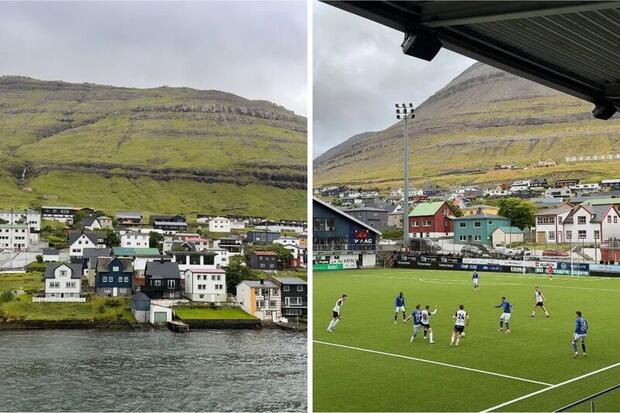
Klaksvík as seen from the water (left) & KI Klaksvík vs B36 Tórshavn (right)
We then made a quick stop in the village of Mikladalur en route back to the port, from which we caught the ferry back to Klaksvík, arriving just in time for our next, much anticipated activity: the Faroe Islands Premier League fixture between KI Klaksvík and B36 Tórshavn. We were able to park right outside the stadium and buy tickets on the door for our very first taste of Faroese football. Reigning champions KI Klaksvík ran out deserved 2-0 winners in an entertaining contest, proving themselves to be a cut above the away side from the capital. Football has grown over the years to become a deeply ingrained part of Faroese culture, as most towns and villages have access to their own pitch – many of them in truly spectacular settings – and it was a pleasure to get a taste of this for ourselves.
Day three – Mykines & Trælanípa
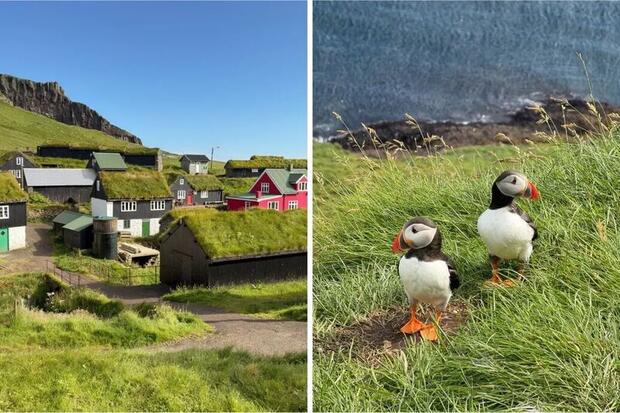
Mykines village (left) & puffins of Mykines (right)
The following day involved another ferry crossing, this time departing from the village of Sørvágur on Vágar island. We were heading to Mykines, one of the most remote and sparsely inhabited islands in the Faroes, with just one tiny settlement nestled among rolling meadows near the island’s western tip. After docking at the harbour, we made our way up to the village via a steep set of concrete stairs and set off on a guided hike, passing through a sheep farming area before arriving at a clifftop with sweeping views of the island’s grassy interior and dramatic, rocky coastline.
The main reason to make the trip to Mykines is to see puffins; between May and August, around 250,000 Atlantic puffins nest and breed in burrows on the grassy hillsides and cliff edges of the island. Throughout our hike, we were able to spot hundreds of puffins up close, and many more at a distance. I’d been fortunate enough to see puffins previously on the east coast of Iceland, but this was a whole different level in terms of the sheer scale of the colony. After a good while observing and taking photographs of these beautiful birds, we descended back towards the village, which looked like something straight from a postcard. It’s not uncommon for the ferry to and from Mykines to be cancelled due to rough seas and strong winds, so we were incredibly grateful to be blessed with a still, sunny day for this trip – something that’s not to be taken for granted in the Faroe Islands.
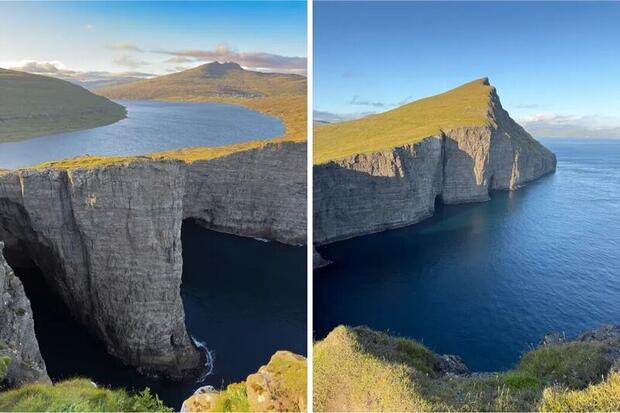
The view from Trælanípa
Soon after docking back in Sørvágur just after 7pm, we decided to make the most of the opportunity to tackle another of the most renowned hikes in the Faroe Islands – the trail to Trælanípa, also known as ‘the lake above the ocean’. As we set off, the sun was hanging low in the sky, casting a warm, golden glow across Lake Sørvágsvatn and the surrounding mountains. It was the perfect time of day for this particular hike, and after 35 minutes or so, we reached the clifftop viewpoint looking back towards the ‘floating’ lake with the ocean in the foreground – a magnificent spectacle, which surely ranks among the most stirring panoramas in the entire archipelago.
Rather tired but hugely satisfied from a day filled to the brim with adventure, we enjoyed a well-earned dinner at a simple roadside restaurant in the village of Miðvágur before returning to Tórshavn for the night.
Day four – Saksun, Tjørnuvík, Gjógv & Ress Spa at Hotel Føroyar
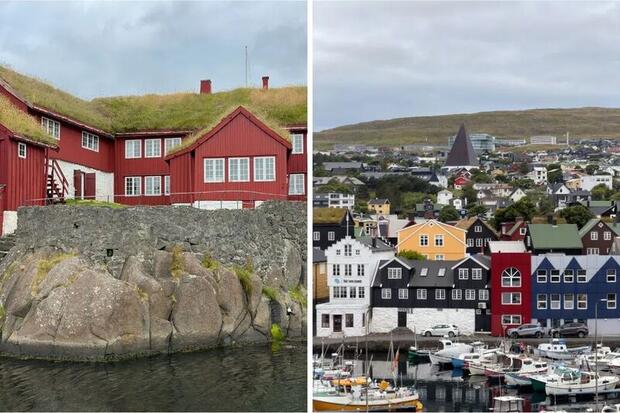
Tórshavn old town
On our final full day, a couple of us took the opportunity to explore the old town Tórshavn (Reyn) early in the morning when the streets were completely deserted. We began by strolling down to the west harbour, which is lined by a row of colourful wharf buildings that look a little like a smaller version of Nyhavn in Copenhagen, before winding our way among the cobbled lanes of the Tinganes peninsula. This is the oldest and most characterful part of the city, featuring a warren of black-tarred, turf-roofed houses that date back to the 14th and 15th centuries, as well as a cluster of red timber buildings that have historically served as the headquarters of the Faroese government. This whole neighbourhood is wonderfully atmospheric, and exploring it really does feel like stepping back in time to another era.
Later in the morning, we set out on the ‘Golden Circle’ route of the Faroe Islands – a string of standout attractions in the northern reaches of the islands of Streymoy and Eysturoy. The first of these was Saksun, a tiny village nestled deep within a grassy valley on the edge of a tidal lagoon. Its collection of beautifully preserved turf-roofed buildings belong to a historic farm, Dúvugarðar, that dates back to the 16th century, while the white village church overlooking the lagoon is among the most picturesque in the Faroes.
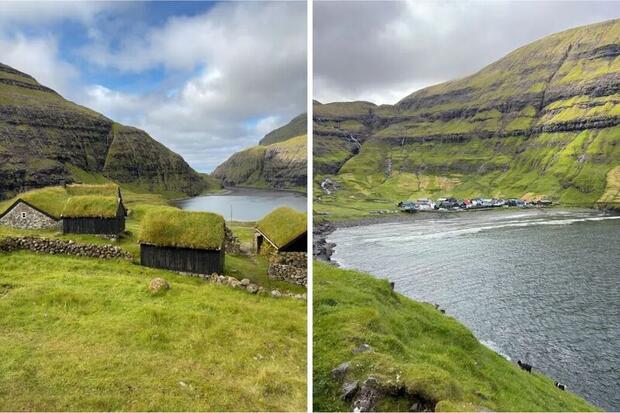
Saksun (left) & Tjørnuvík (right)
Continuing north along the rugged coastline of Streymoy, we made a brief pitstop at Fossá – the tallest waterfall in the Faroe Islands, with a two-tiered cascade tumbling down a sheer mountain face – before making our way to the next village, Tjørnuvík. Huddled in a bay between the mountains and a black sand beach at the northern tip of Streymoy, Tjørnuvík is one of the archipelago’s most dramatically situated villages and a popular spot for surfers who come to ride the swells that roll in from the North Atlantic. This was one of the busier spots we visited, with just one small car park and a single-lane road with traffic lights controlling access in and out, but it was worth staying patient as the views (especially from the hillside behind the village) were terrific. As it was another bright and clear day, we were also able to spot the distinctive Risin og Kellingin sea stacks on the horizon.
The next part of our Golden Circle road trip brought us across to Eysturoy island and the rather charming village of Eiði, where we stopped for coffee and delicious homemade pastries at Café Glottin (highly recommended). Then, after weaving along the mountain pass that skirts beneath Slættaratindur (the tallest peak in the Faroe Islands at 880 metres), we stopped just above the village of Funningur for a short hike to Hvíthamar – an epic viewpoint overlooking the pyramid-shaped green mountains and silvery-blue fjords of Eysturoy.
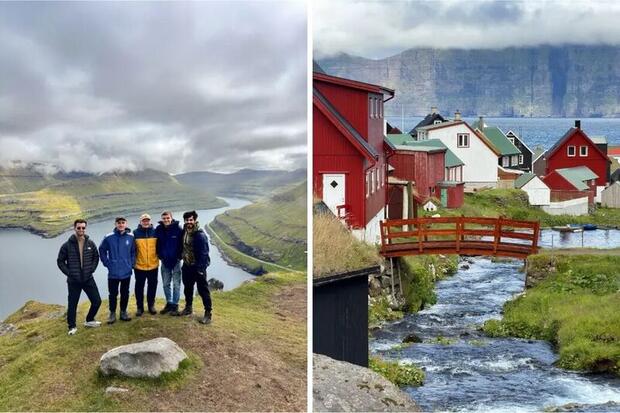
Hvíthamar viewpoint (left) & Gjógv (right)
Our final stop before returning to Tórshavn was Gjógv, perhaps the most idyllic village in the Faroe Islands, which sits on the edge of a sea-filled gorge between towering mountains and cliffs that slope down to the frothing waves of the North Atlantic. Its colourful wooden buildings are dotted either side of a small stream, and make for an endless array of photo opportunities. We also made a short hike up the grassy hillside above the village for a more expansive panorama of Gjógv and its awe-inspiring surroundings, during which we spotted several puffins nestling on the cliff edge. From here, we could also see the looming cliffs of Kalsoy (where we’d hiked a couple of days prior) rising from the ocean in the distance.
Back in Tórshavn, we arrived at the Ress Spa at Hotel Føroyar, which earned a place on TIME’s prestigious World’s Greatest Places of 2026 list. Carved into a hillside overlooking Tórshavn, the Ress Spa is an oasis of serenity that blends seamlessly into the rugged landscape, pioneering a new era in Faroese wellness. In 2021 it became the first ever full-scale luxury spa in the archipelago, and in 2025 it opened with brand new and expanded facilities in a sleek, grass-roofed spa house that’s linked to the main hotel building via a wooden footpath burrowed into the earth. Here, you’ll find indoor and outdoor warm pools, a couple of saunas, a cold plunge pool, a steam room and a relaxation room with floor-to-ceiling windows looking out over the wooded hillside.
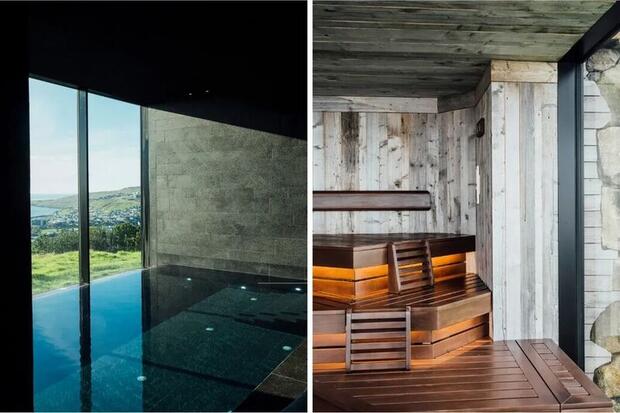
Ress Spa, Hotel Føroyar
We spent a couple of hours making use of the superb facilities, and while it doesn’t have the geothermal aspect of Iceland’s many renowned spas and lagoon complexes, we were thoroughly impressed by the whole Ress Spa experience. After several immensely rewarding but long, action-packed days exploring the majestic landscapes of the Faroe Islands, it was a pleasure to slow down, unwind and rejuvenate in such tranquil surroundings. The Ress Spa was the perfect finale to our trip – followed by a delicious dinner at the Ruts Restaurant next door – and I’d heartily recommend it to anyone when visiting the Faroe Islands.
Top tips for visiting the Faroe Islands
- If you’re intending to visit Kalsoy or Mykines in the summer months, be sure to book your ferry tickets well in advance; car spaces on these highly popular routes often sell out days or even weeks ahead.
- If you’re confident driving abroad, hiring a car is the best way to get the most out of your time in the Faroe Islands, as it offers maximum flexibility and the freedom to plan each day as you wish. You’ll also want to make plenty of impromptu photo stops – and remember, sheep always have the right of way!
- Don’t stress too much about the weather forecast; the conditions tend to change rapidly in the Faroe Islands, and the topography of the archipelago creates highly variable and location-specific microclimates. As such, you’ll often encounter totally different conditions driving from one island or fjord to the next (and indeed, from one hour to the next).
- Good hiking boots and a proper waterproof jacket are essential; hiking is one of the standout activities in the Faroes, but you should be prepared for the possibility of wet, slippery conditions and heavy winds.
- When hiking, keep well clear of cliff edges – especially in windy conditions. Many popular hikes in the Faroe Islands have sharp drops without barriers or fences, so tread wisely and don’t take unnecessary risks for the perfect photograph.
- Don’t overlook Tórshavn; while it’s tempting to spend much of your time on day trips to areas outside of the capital, Tórshavn is full of character and warrants at least a good few hours’ exploration. This is also where you’ll find the best choice of places to eat and drink.
- Remember that while Faroese turf-roofed houses are very charming and picturesque, many of these are people’s real homes – so always keep a respectful distance and bear in mind people’s privacy when taking photographs.
- You don’t need to bring cash with you; almost everywhere in the Faroe Islands accepts card payments.